
Buying a Home in 2026 Is Hard – But Not Impossible
Let me be honest with you.
This is not the easiest time to buy a house in America. Mortgage rates are sitting in the mid-6% range for a 30-year fixed loan. Median home prices nationally are hovering around $415,000–$430,000. And the share of first-time buyers has dropped to roughly one in five purchases, an all-time low.
That means millions of Americans who want to own a home are sitting on the sidelines, either priced out or paralyzed by the process.
But here’s what those headlines don’t tell you: people are still buying homes every single day. The ones who succeed aren’t luckier or richer. They’re more prepared.
This guide walks you through exactly how to buy a house in 2026, step by step, document by document, mistake by mistake.
Whether you’re a first-time buyer in Phoenix or a renter in Dallas ready to stop paying someone else’s mortgage, this is the roadmap you need.
Also read: 10 Most Affordable Housing Markets in America for 2026 (You Won’t Believe #7!)
What You’re Actually Walking Into: The 2026 Housing Market
Before you fall in love with a listing, understand the environment you’re buying in.
Mortgage rates are elevated but manageable. The 30-year fixed rate is in the mid-6% range as of early 2026. That’s meaningfully higher than the pandemic lows of 3%, but well below the 18% rates of the early 1980s. The keyword is adjustment; buyers today are adjusting expectations, not giving up.
Home prices are high but cooling in some markets. National medians are around $415,000-$430,000, but that number masks enormous variation. A $400,000 budget gets you a very different home in Memphis, Tennessee versus Miami, Florida. Your local market matters far more than the national average.
Inventory is slowly improving. More sellers are listing, which gives buyers slightly more negotiating room than in 2022–2023. In many mid-size cities, you can now ask for repairs, seller credits, and reasonable closing timelines without losing the deal.
First-time buyers face the steepest climb. With student debt, high rents, and elevated prices, getting that first down payment together takes longer than it used to. But first-time buyer programs, at the state, city, and federal levels, exist specifically for this reason. More on that below.
Also read: How Much House Can I Afford? A Simple Guide for US Buyers
Step 1: Get Your Finances in Order (Months 1–6)
This is the step most buyers rush past. Don’t.
Everything that follows, your loan approval, your interest rate, your monthly payment, traces back to the financial groundwork you lay here.
Know your credit score. Pull your free report at AnnualCreditReport.com. For a conventional loan, aim for 680 minimum; 740+ gets you the best rates. FHA loans go as low as 580. If your score needs work, spend 3-6 months paying down balances and disputing any errors before applying anywhere.
Calculate your debt-to-income ratio (DTI). Add up all your monthly debt payments, car, student loans, credit cards, and divide by your gross monthly income. Lenders want this under 43%. Under 36% is where you’re in strong shape.
Build your savings target. You need three buckets of money, not one:
- Down payment (3–20% of purchase price)
- Closing costs (2–5% of loan amount – often $6,000–$15,000)
- Emergency fund (keep 3-6 months of expenses after closing – do not drain this)
Real example: Maria is a 29-year-old nurse in Dallas earning $80,000/year. She wants a $350,000 home. She spends 14 months paying her credit card from $8,000 down to $1,500, saves $21,000 for a down payment and closing costs, and keeps $10,000 in her emergency fund untouched. When she applies, her DTI is 31%. She gets approved at a competitive rate. The prep work was the work.
Stabilize your employment. Lenders want two years of consistent income in the same field. If you’re planning a career change, try to do it after closing, not during the process.
Step 2: Get Pre-Approved – Not Just Pre-Qualified (Month 4–7)
These two terms sound similar. They are not.
Pre-qualification is a quick estimate based on numbers you tell the lender. It takes 10 minutes and means almost nothing to a seller.
Pre-approval means the lender has actually reviewed your documents, pulled your credit, and conditionally committed to lending you a specific amount. In 2026’s market, sellers often won’t even entertain an offer without it.
Talk to at least three lenders. A traditional bank, a credit union, and an online lender. Interest rates and fees vary more than most buyers realize. On a $350,000 loan, a 0.25% rate difference saves or costs you roughly $15,000-$18,000 over the life of the loan. Spend the extra hour, it’s worth it.
Documents you’ll need at pre-approval:
- Government-issued ID
- Last 2–3 months of pay stubs
- Last 2 years of W-2s (or tax returns if self-employed)
- Last 2–3 months of bank statements
- Statements for retirement or investment accounts
- Documentation for any additional income (bonuses, freelance, child support received)
One important warning: Getting pre-approved does not mean you should spend up to that number. Lenders approve the maximum they’ll loan you, not the maximum you should comfortably borrow. Your budget and their limit are two different things. Stay on your side of that line.
Also read: 7 Genius Ways to Save Money on Mortgage in 2026 (Without Refinancing!)
Step 3: Search for Homes – Smartly (Months 5-9)
Now the part everyone wants to jump to first. House hunting.
Define your non-negotiables before you start. Bedrooms, commute distance, school district, HOA vs. no HOA, know your list before you fall in love with a kitchen. Emotions move fast in a home search. Your criteria list keeps you grounded.
Use online tools, but don’t stop there. Zillow, Realtor.com, and Redfin show you listings, price history, days on market, and estimated payments. Set up email alerts for your target area and price range so you see new listings the day they hit.
Drive neighborhoods on a Saturday morning and a Tuesday night. Photos don’t show you the traffic, the noise from a nearby highway, or whether the neighborhood actually feels right. Your gut during an in-person visit tells you things no algorithm can.
Find a buyer’s agent who respects your budget. In most US transactions, the seller pays a commission that is split with your buyer’s agent, so representation typically costs you nothing directly. A good agent will flag overpriced homes, spot red flags in photos, and help you write a competitive offer.
A bad one will push you toward the top of your budget every time. Interview two or three before committing.
Look at days on market. Homes sitting for 30+ days in your area may have room to negotiate. Fresh listings in competitive neighborhoods may need offers at or above list price within 48 hours. Your agent should know the rhythm of your local market.
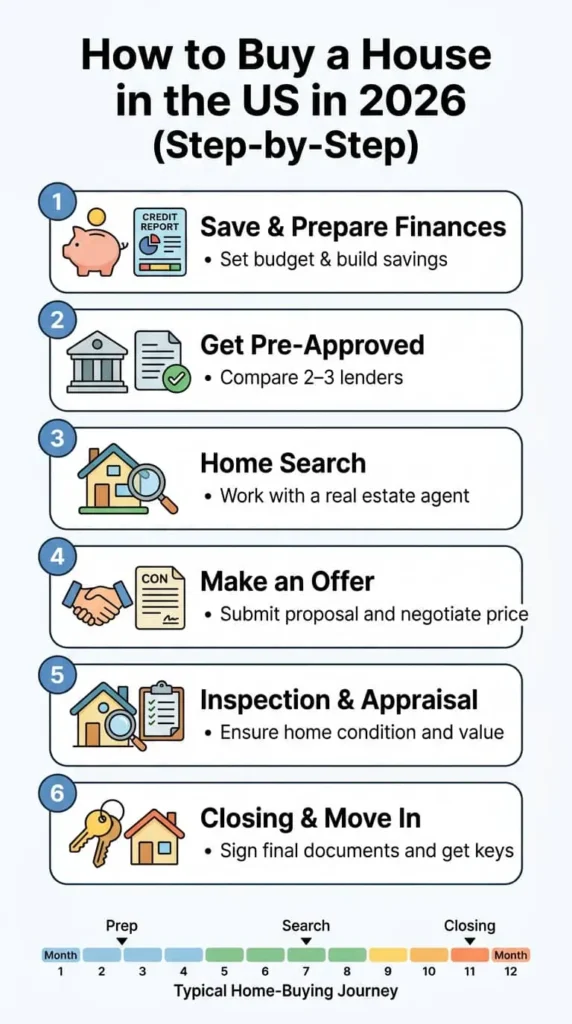
Step 4: Make an Offer and Negotiate
You found the home. Now you need to win it, without overpaying or overexposing yourself.
A strong offer includes:
- Your offer price (informed by comparable sales, not emotion)
- Earnest money deposit (typically 1-3% of the price, shows you’re serious)
- Contingencies: financing, inspection, appraisal
- Requested closing timeline (30-45 days is standard)
- Any personal property you want included (appliances, fixtures)
Negotiation is normal. In today’s more balanced market, you can often ask for seller credits toward closing costs, repair credits after inspection, or a longer closing period. What you can get depends entirely on how competitive your specific market and neighborhood is.
Do not waive your inspection contingency unless you genuinely understand the risk. Waiving inspection means you’re agreeing to buy the home regardless of what’s inside the walls.
Foundation issues, outdated electrical panels, and failing HVAC systems can cost $20,000-$80,000 to fix. If the market requires being aggressive, negotiate a shorter inspection window (5-7 days) rather than skipping it entirely.
Step 5: Inspection, Appraisal, and Final Loan Approval (2–4 Weeks)
Your offer is accepted. Take a breath, but don’t relax completely. This stage is where deals fall apart.
The home inspection is your opportunity to understand exactly what you’re buying. Hire your own licensed inspector (not one recommended by the seller’s agent). A thorough inspection covers the roof, foundation, electrical, plumbing, HVAC, and more. Expect to pay $300–$600, depending on location and home size. It is always worth it.
After the inspection, you can:
- Accept the home as-is
- Request specific repairs before closing
- Ask for a price reduction or closing cost credit in lieu of repairs
- Walk away if issues are severe (if your inspection contingency is in place)
The appraisal is ordered by your lender to confirm the home is worth what you’re paying. If it comes in low, say you offered $380,000 but it appraises at $360,000, you’ll need to renegotiate, make up the difference in cash, or walk away.
Final loan approval (underwriting) is the lender’s last internal review. They’ll verify your documents one more time and confirm nothing has changed. This is not the moment to make large financial moves.
Critical: Do not do any of the following between offer acceptance and closing:
- Open new credit cards or take out new loans
- Finance a car, furniture, or appliances
- Make large unexplained deposits into your bank account
- Switch jobs without telling your lender immediately
Any of these can change your DTI, trigger a new credit pull, and kill your approval, sometimes days before closing.
Step 6: Close and Get Your Keys (Days 30–60 After Accepted Offer)
The finish line.
Three business days before closing, you’ll receive your Closing Disclosure (CD), a detailed breakdown of your final loan terms, monthly payment, and all closing costs. Read it carefully and compare it to your original Loan Estimate. Question anything that changed significantly.
At the closing table, you’ll sign:
- Promissory Note – your legal promise to repay the loan
- Deed of Trust / Mortgage – secures the lender’s interest in the property
- Closing Disclosure acknowledgment
- Title documents
You’ll also bring a cashier’s check or arrange a wire transfer for your closing costs and any remaining down payment. Personal checks are typically not accepted at closing.
Then you get the keys.
Web Story: How One Grocery Swap Saved a Single Mom $200/Month
First-Time Buyer Programs Worth Knowing in 2026
This section alone could save you thousands of dollars, yet most first-time buyers never look into it.
State housing finance agencies in almost every US state offer below-market mortgage rates, down payment assistance, and sometimes forgivable second loans for first-time buyers. Search “[your state] housing finance agency first-time buyer program.”
FHA loans remain one of the most accessible paths to homeownership – 3.5% down with a 580+ credit score, and more flexible DTI requirements than conventional loans.
VA loans offer zero down payment for eligible veterans, active-duty service members, and surviving spouses. If you qualify, this is often the best mortgage product available.
USDA loans offer zero down payment for homes in eligible rural and suburban areas. More locations qualify than most buyers assume – check the USDA eligibility map.
Good Neighbor Next Door offers significant discounts for teachers, firefighters, EMTs, and law enforcement buying in certain communities.
Ask every lender you talk to about programs you may qualify for. Many don’t volunteer this information unless you ask directly.
6 Mistakes That Derail First-Time Buyers
1. Shopping for homes before talking to a lender.
You’ll fall in love with homes outside your budget. Lender first, Zillow second. Always.
2. Forgetting what homeownership actually costs monthly.
Your mortgage payment is not your only housing cost. Add property taxes, homeowner’s insurance, HOA fees if applicable, and maintenance. A common estimate for maintenance alone is 1% of the home’s value per year, $350,000 home = roughly $3,500/year in expected upkeep.
Also read: Fixed vs. Adjustable-Rate Mortgage: Which One Should You Choose in 2026?
3. Emptying every account for the down payment.
If something breaks in month two, the water heater, the AC, the roof, you need cash. Buyers who drain everything for the down payment often end up on high-interest credit cards for their first emergency. Keep that reserve fund.
4. Ignoring property tax differences by location.
A $400,000 home in Texas can carry $8,000–$10,000/year in property taxes. The same value home in Alabama might be $2,000/year. This is a massive monthly payment difference that online calculators often underestimate. Always verify local tax rates before falling in love with a listing.
5. Letting emotions override the spreadsheet.
Every experienced buyer has a story about the house they “had to have” and offered $30,000 over asking on. Sometimes it works out. Sometimes it sets them back years. The house that fits your life and your budget will always beat the house that just felt perfect in photos.
6. Not asking about first-time buyer programs.
Leaving free money on the table because you didn’t ask one question. Don’t be that buyer.
Your 6-12 Month Home Buying Timeline
| Phase | Timeframe | What to Do |
| Financial prep | Months 1–6 | Improve credit, pay down debt, build savings |
| Pre-approval | Months 4–7 | Gather documents, talk to 3 lenders |
| Home search | Months 5–9 | Define criteria, hire agent, tour homes |
| Offer & negotiation | Months 6–10 | Write offer, negotiate terms and contingencies |
| Inspection & appraisal | 2–4 weeks post-offer | Inspect, negotiate repairs, lender appraisal |
| Final approval & closing | 30–60 days post-offer | Sign documents, wire funds, get keys |
You can compress this to 3–4 months if your finances are already solid. Give yourself the full 12 if you’re starting from scratch, rushing the foundation is where most mistakes happen.
Also read: 10 Proven Ways to Lower Your Closing Costs (Save $3,000+ on Your Home Purchase)
Key Takeaways
- The 2026 market is tough but navigable; preparation beats timing
- Pre-approval is non-negotiable; talk to at least three lenders and compare
- Your real budget = lender maximum minus your comfort margin
- Never drain your emergency fund for a down payment
- Always get a home inspection, no exceptions
- First-time buyer programs exist in almost every state; ask about them
- Don’t make any major financial moves between offer acceptance and closing
- Think in total monthly cost: mortgage + taxes + insurance + HOA + maintenance
- A 5–7 year time horizon makes almost any purchase decision more rational
- The best time to start is 6-12 months before you want to close
FAQs
Q: How much down payment do I actually need in 2026?
You don’t need 20%. Conventional loans go as low as 3–5%, FHA loans as low as 3.5% with a 580+ credit score, and VA and USDA loans offer zero down for eligible buyers. The trade-off is higher monthly payments and often mortgage insurance. Run the actual numbers with a lender before deciding how much to put down.
Q: Is 2026 a bad time to buy because rates are high?
Not necessarily. Higher rates mean higher payments, but they’ve also cooled some of the frenzied bidding wars. If you find a home that fits your budget and plan to stay 5-7 years, you’re buying a home, not a rate. Rates can be refinanced later. Location and price cannot be undone.
Q: How long does the full process take?
If your finances are ready, 60-90 days from pre-approval to closing is realistic. If you’re still saving and building credit, budget 9-12 months for the full journey. The preparation phase is not wasted time, it’s what makes everything after it easier.
Q: Do I really need a buyer’s agent?
In most US markets, yes, especially as a first-time buyer. The seller typically pays the commission split, so you generally get professional representation at no direct cost to you. A good agent catches problems, negotiates on your behalf, and guides you through paperwork. A bad one rushes you. Interview a few before choosing.
Q: What’s the single most important thing I can do today to buy a house?
Pull your credit report. Free at AnnualCreditReport.com. Know your score, list your debts, and understand your DTI. That 30-minute exercise tells you exactly how far you are from being ready, and what needs to happen between now and your closing date.