

Buying your first home is a big deal.
Picking from the best mortgage lenders can feel even bigger. Everyone promises “low rates” and “fast closings,” but as a first‑time buyer, it’s hard to know who actually fits you best.
Here’s the good news: you don’t need to be a finance pro to make a smart choice. You just need to understand the main types of lenders, what to compare, and how to shop without getting pushed into a bad deal.
This guide is written for US first‑time homebuyers. It’s an educational overview, not a sponsored list. You’ll learn how to think about the best mortgage lenders, how to compare them, and how to walk away if something feels off.
Disclaimer: This article is for educational purposes only and is not financial advice. Any lenders mentioned are examples, not endorsements or recommendations. Always compare offers and review current terms before choosing a mortgage lender.
Why “best mortgage lenders” is the wrong first question
Most people start with “Who are the 10 best mortgage lenders in the US?”
That sounds logical, but it misses something important: the best mortgage lenders for you depend on your credit, income, down payment, location, and comfort level with tech and risk.
Industry lists show that big non‑bank mortgage companies and large banks handle a huge share of US home loans every year. That proves they’re popular and established.
It does not prove they’re always the best fit for a first‑time buyer with your exact profile.
So instead of chasing one magic name, this guide shows you 10 “best fit” lender types and then helps you compare offers so you can choose with confidence.
10 “best mortgage lender” profiles for first‑time buyers
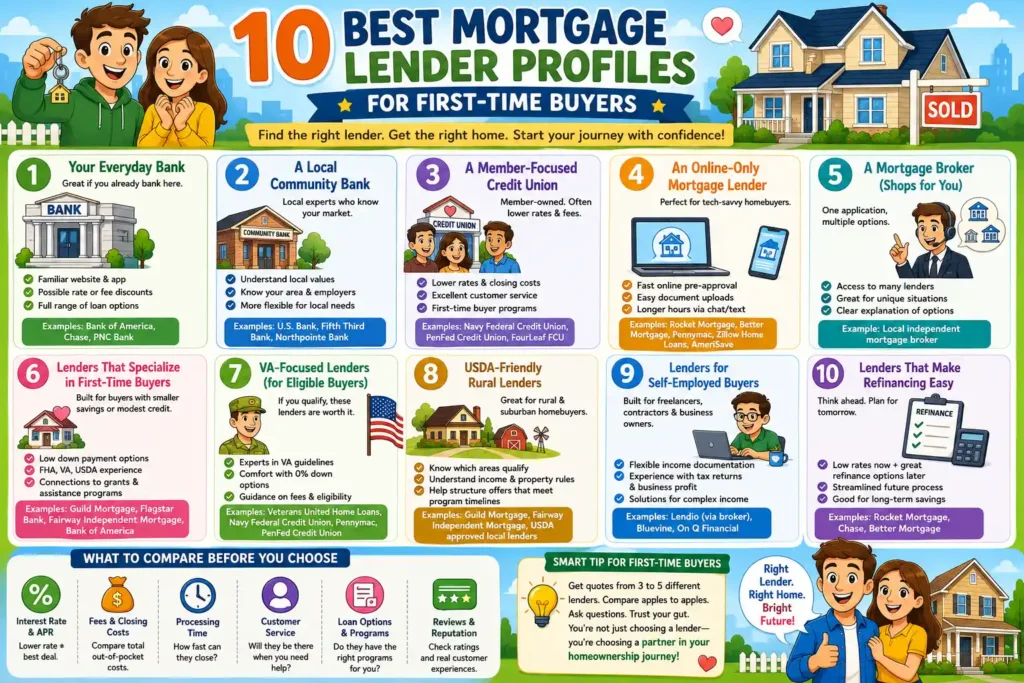
Use this listicle as a menu. You don’t need all 10. Aim to get quotes from three to five different lenders that match you best.
1. Your everyday bank
If you already have checking and savings at a big national or regional bank, they might be one of the best mortgage lenders for you.
Why they can be a good fit:
- You already know the website and app.
- They may offer small rate or fee discounts for existing customers.
- They usually have a full range of loan types.
Watch out for: slower processes and less personal attention at very large institutions.
Examples: Bank of America, Chase, PNC Bank
Also read: 5 Cheapest States to Buy a House in the U.S. (And the Catch Behind Them)
2. A local community bank
Local banks focus on a smaller area and often know the local market very well.
Why they can be one of the best mortgage lenders:
- Better feel for local property values and quirks.
- More likely to know your employer or neighborhood.
- Often more flexible for unique local situations.
Watch out for: fewer online tools or branches outside your city.
Examples: U.S. Bank, Fifth Third Bank, Northpointe Bank
3. A member‑focused credit union
Credit unions are member‑owned. Many US guides point out that they often offer very competitive rates and lower fees for members.
Why they can be a strong option:
- Lower average rates and closing costs compared to some big banks.
- Very customer‑service focused.
- First‑time buyer programs and education workshops are common.
Watch out for: membership rules and occasionally clunky tech
Examples: Navy Federal Credit Union, PenFed Credit Union, FourLeaf Federal Credit Union
4. An online‑only mortgage lender
Online lenders have grown fast and now originate a large share of US mortgages.
Why they may feel like the best mortgage lenders to tech‑savvy buyers:
- Fast online pre‑approval and document upload.
- Easy rate comparisons on your laptop or phone.
- Extended hours via chat, text, or phone.
Watch out for: less face‑to‑face support and more “call center” feel.
Examples: Rocket Mortgage, Better Mortgage, Pennymac, Zillow Home Loans, AmeriSave
Also Read: Stop Overpaying Interest: 3 Smart Tips to Pay Off Your Mortgage Faster
5. A mortgage broker who shops for you
A broker doesn’t lend their own money. Instead, they collect your info and shop multiple lenders on your behalf.
Why a broker can connect you to the best mortgage lenders:
- One application, many potential options.
- Helpful if you have self‑employment income or a thin credit file.
- Can explain differences between loan offers in plain English.
Watch out for: added broker fees and the fact that not every lender works with every broker.
Example: Use a local independent mortgage broker in your city (many of the wholesale lenders ranked in national broker/VA rankings, such as those in Scotsman Guide’s VA lender lists, work through broker networks)
Here’s a quick visual guide to the best mortgage lenders for first-time buyers –
6. Lenders that specialize in first‑time buyers
Some lenders lean hard into first‑time homebuyer programs.
What to look for:
- Low down‑payment options (3–5 percent).
- Experience with FHA, VA, or USDA loans where relevant.
- Relationships with local down‑payment assistance programs or grants.
These can be some of the best mortgage lenders for buyers with smaller savings or modest credit.
Examples: Guild Mortgage, Flagstar Bank, Fairway Independent Mortgage, Bank of America (down‑payment assistance focus)
Also read: What Is a Mortgage? Complete Beginner’s Guide for First-Time Buyers in the USA
7. VA‑focused lenders (for eligible buyers)
If you’re active‑duty military, a veteran, or a qualifying spouse, VA loans are a huge benefit.
Why VA‑focused lenders can be ideal:
- Deep experience with VA guidelines and paperwork.
- Comfort with 0 percent down structures where allowed.
- Better guidance on funding fees and eligibility.
If you qualify, it’s smart to include at least one VA‑heavy lender in your quote list.
Examples: Veterans United Home Loans, Navy Federal Credit Union, Pennymac, PenFed Credit Union
8. USDA‑friendly rural lenders
Buying in a rural or certain suburban area? USDA loans may offer low or zero down payments within income and location limits.
Why a USDA‑savvy lender helps:
- Knows which areas qualify.
- Understands income caps and property rules.
- Can structure your offer to meet program timelines.
If your target town is smaller and more rural, this kind of lender may be one of the best mortgage lenders you can find.
Examples: U.S. Bank, Fairway Independent Mortgage Corporation, Flagstar Bank, Guild Mortgage, Movement Mortgage
Also Read: 7 Genius Ways to Save Money on Mortgage in 2026 (Without Refinancing!)
9. Lenders known for fast closings
In hot markets, a slow lender can cost you the house.
Signs a lender is strong on speed:
- Clear closing‑time averages (for example, “we usually close purchases in about 30 days”).
- In‑house processing and underwriting.
- Good communication with local agents and title companies.
If your seller cares about speed, a dependable, quick lender might beat a slightly cheaper but slower one.
Examples often cited for streamlined online closings: Rocket Mortgage, loanDepot, AmeriSav
10. Lenders with great communication and reviews
For a first‑time buyer, clear, patient guidance is priceless.
How to spot these “best mortgage lenders” in the wild:
- Consistent positive reviews about communication, not just low rates.
- Friends, family, or your agent say they had a good, low‑stress experience.
- Your gut feeling after a 15‑minute call is “They listen and explain things well.”
If a lender is rude or brushes off your questions during the first call, that’s a red flag.
Examples: Guild Mortgage, CMG Financial, Movement Mortgage, Veterans United
What to actually compare between the best mortgage lenders
Once you have a short list, use this decision checklist.
1. Rate and APR (total cost)
- Rate affects your monthly payment.
- APR bundles rate plus certain fees so you can compare total cost from one lender to another.
Two lenders might have similar rates but very different fees. Look at APR to see who is truly cheaper over time.
2. Fees and closing costs
Pay attention to:
- Origination or underwriting fees
- Discount points (optional)
- Estimated third‑party fees
Your official Loan Estimate from each lender will show these. Comparing closing costs is a big part of choosing the best mortgage lenders for your wallet.
3. Loan options and flexibility
Ask each lender:
- Which fixed‑rate loan terms do you offer (15‑, 20‑, 30‑year)?
- Do you support FHA, VA, USDA, and low down‑payment conventional loans?
- How do you treat self‑employed income or student loans?
You want the best mortgage lenders for your income and credit story, not someone else’s.
4. Service, speed, and support
- How fast do they respond to calls and emails?
- Do you get a single point of contact or are you passed around?
- Can they realistically close before your contract deadline?
Guides for buyers stress that slow or poor communication can derail deals even when rates are fine.
Simple comparison table you can recreate
Here’s a simple way to compare three of the best mortgage lenders for your situation. Use real numbers from your Loan Estimates.
| Feature | Lender A | Lender B | Lender C |
| Rate (30‑yr fixed) | 6.6% | 6.5% | 6.5% |
| APR | 6.9% | 6.8% | 6.7% |
| Estimated lender fees | $1,500 | $2,200 | $2,000 |
| Est. days to close | 30 | 40 | 28 |
| First‑time buyer programs? | Yes | Yes | No |
| Communication | Local rep | Call center | Online + phone |
Looking at this, the “best” choice might be Lender C, even if Lender B has a similar rate, because APR and fees are lower and speed is better. This is exactly how you separate marketing from real value.
How to shop the best mortgage lenders without getting overwhelmed
Step 1: Pick 4-5 lenders to contact
Mix it up:
- One big bank
- One credit union
- One online lender
- One broker or strong local lender
Studies and consumer guides say that talking to three to five of the best mortgage lenders you can find may save you serious money over the life of your loan.
Step 2: Ask each for the same scenario
For example:
“I’m buying a 400,000‑dollar home with 10 percent down, 30‑year fixed, primary residence.”
Ask every lender to quote that exact setup so you can compare apples to apples.
Step 3: Get quotes in a short window
Try to collect quotes within about a week. Rates move daily, and getting them close together makes comparisons fairer. Research also notes that grouping mortgage checks into a short window can limit the impact on your credit score.
Step 4: Use one lender’s offer to improve another
You’re allowed to say:
“Another lender offered a lower APR and lower fees. Can you match or beat it?”
Experts and lender guides agree that this kind of rate shopping is normal and can push the best mortgage lenders to give you a sharper deal.
Key takeaways
- There is no single list of best mortgage lenders that works for everyone. The right fit depends on your budget, credit, and comfort with tech and risk.
- Focus on lender types: big banks, community banks, credit unions, online lenders, brokers, and niche first‑time or VA/USDA lenders.
- Compare rate, APR, fees, programs, speed, and service, not just one headline number.
- Get quotes from at least three to five of the best mortgage lenders you can find. More quotes usually mean more savings over the life of the loan.
- Trust your gut on communication. A lender who listens, explains, and responds quickly is worth a lot when you’re buying your first home.
For more timeless insights on building wealth and managing money wisely, check out the bestselling book Rich Dad, Poor Dad: What The Rich Teach Their Kids About Money.
FAQs about the best mortgage lenders
1. How many mortgage lenders should I get quotes from?
Most experts suggest quotes from at least three lenders, and some research shows four or more can save borrowers hundreds of dollars per year in interest. More quotes = more chances to find a better deal.
2. Do multiple mortgage quotes hurt my credit?
Mortgage inquiries within a short time window are often treated as one “shopping event” by credit scoring models, so the impact is usually small if you keep your quote window tight. It’s a normal part of finding the best mortgage lenders.
3. Are the biggest lenders always the best mortgage lenders?
Not always. Large non‑bank and bank lenders handle many US loans, but that only proves size, not that they’re the best choice for your income, credit, and location. You still need to compare offers.
4. Is an online lender better than my local bank or credit union?
Online lenders can be fast and convenient, while banks and credit unions may offer strong rates and more personal help, especially if you already bank with them. The best approach is to include both types in your quote list.
5. What’s the biggest red flag when picking a mortgage lender?
Be cautious if a lender is pushy, won’t give you a clear written estimate, dodges questions about fees, or seems annoyed that you’re shopping around. The best mortgage lenders welcome your questions and respect that you’re comparing options.